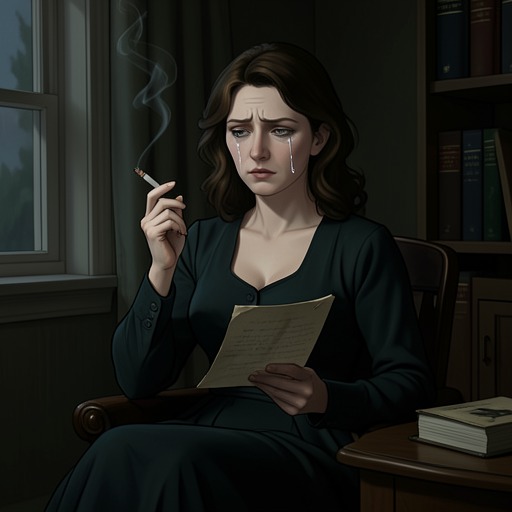
Vesper Lynd’s suicide
Casino RoyaleVesper Lynd’s suicide ends her relationship with James Bond and reveals the secret that had shaped it: she had worked for the MWD as a double agent under pressure, yet had refused to continue spying on Bond after falling in love with him. The sleeping pills she takes bring the novel’s private love story and espionage plot together in a single aftermath: Bond discovers her body, then reads her farewell and learns both why she betrayed him and why she believed she could not go on.
Discovery and immediate aftermath
The event comes to Bond through a morning interruption. The patron brings a letter to Bond’s room, alarmed by what he describes as a terrible accident. Bond rushes to Vesper’s open room, where daylight enters through the shutters. She lies beneath the sheet, apparently asleep, but Bond realizes she is dead.
The room’s ordinary belongings make the discovery intimate rather than investigative. Beside Vesper are her book, cigarettes, matches, mirror, lipstick, and handkerchief. An empty glass and the sleeping-pill bottle identify the immediate means of death; Bond recognizes the pills as those he had seen in the bathroom on the evening they first arrived. The scene confirms that Vesper has taken her own life, but the letter she leaves supplies the history and decisions behind that act.
Bond asks the patron to notify the Commissaire and says he will wait in his room. Before opening the envelope, he thinks Vesper may have arranged to be called early so that he would not be the person to find her. The thought frames the discovery as a final effort to spare him, even though she has left him to confront the consequences of her death and the truth in her letter.
The farewell and its disclosures
Bond opens the envelope and reads a message addressed to him as her darling. Vesper says that she loves him, but believes that the moment he reads the letter will be the last moment his love can endure. Her farewell thus joins affection to the expectation of rejection: she wants him to know that her love was real while anticipating that her confession will change how he sees her.
The letter identifies her as an agent of the MWD and a double agent for the Russians. She says she was recruited a year after the war and had worked for them ever since. Before Bond, she had loved a Polish airman in the RAF, whom she describes as having received two DSOs. After the war he was trained by M and sent back into Poland, where he was caught and tortured. His captors learned about Vesper and used his life to compel her cooperation.
The arrangement depended on letters arriving from him on the fifteenth of each month. Vesper says she could not bear the thought that a month might pass without his letter, because she would then believe she had caused his death. She presents that attachment as the reason she continued to comply, while insisting that she tried to give the Russians as little information as possible. Her confession makes her espionage neither voluntary loyalty nor a simple betrayal: it arose from pressure exerted through the threatened life of someone she loved.
Vesper also admits that she told her handlers Bond had been assigned to Royale and disclosed his cover. The confession connects her earlier role directly to the danger Bond faced. When she learned what had been done to him, however, she says she could no longer continue. She had begun to love Bond and refused to obtain information from him while he was recovering, although her controllers in Paris demanded it and required her to telephone an Invalides number twice a day.
Surveillance and the decision to die
Vesper writes that her controllers eventually withdrew their control, leaving her to believe that the Polish airman would have to die. She also says they feared she might talk and warned that SMERSH would come for her if she disobeyed. She chose not to obey. Her refusal did not end the danger: at the Splendide she saw a man with a black patch who had been making inquiries about her movements. The encounter, the day before she and Bond came to the coast, convinced her that she was still being watched.
She had hoped to evade that pursuit by beginning an affair with Bond and escaping from Le Havre to South America. She imagined having Bond’s child and starting again elsewhere. The plan collapses when, as she writes, they are followed. Against the possibility of being killed by SMERSH, of having Bond killed as well, or of confessing and ending their love, she says she chose suicide. Her letter presents the decision as a response to an increasingly closed set of alternatives, not as a sudden change of feeling toward Bond.
The message gives Bond two specific leads connected to her espionage: the Paris number Invalides 55200 and an accommodation address at a newsagent’s, 450 Charing Cross Place. She says she had never met her contacts in London. These details extend the farewell beyond personal explanation, leaving actionable traces of the network that controlled her even as the letter explains why she had refused its final demands.
Bond’s response and the event’s significance
After reading the letter, Bond throws it down, brushes his fingers together mechanically, and strikes his temples with his fists. He looks toward the quiet sea, curses, and wipes his wet eyes. The brief sequence records shock and grief through actions rather than an extended explanation: first rejection of the letter, then a physical gesture of distress, then tears that he tries to dry.
Vesper’s death changes the meaning of the couple’s recent relationship. What Bond could have understood as deception is recast by her account as espionage undertaken under threat, followed by a refusal to exploit his vulnerability after she fell in love with him. Yet the letter does not undo the betrayal: she acknowledges that she disclosed his assignment and cover, and Bond must receive the confession only after she has made reconciliation impossible.
The event also closes the immediate personal crisis by exposing how the espionage plot reached into private life. Vesper’s final message identifies the MWD, her Russian handlers, the endangered Polish airman, the surveillance at the Splendide, and the threat from SMERSH. Its farewell is at once an expression of love, an admission of responsibility, and a record of the pressures that made her see death as the remaining escape. For Bond, the discovery leaves grief alongside knowledge: he now understands the concealed history, but cannot question Vesper or alter the choice she has made.